

Brazil, South America
Details
Accessibility
https://visitbrasil.com/?s=Accessibility
Brief description
https://en.wikipedia.org/wiki/Brazil
 São Paulo is considered the main financial centre of Brazil
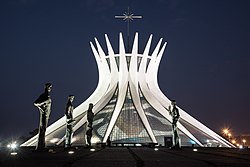
The Cathedral of Brasília, designed by Brazilian architect Oscar Niemeyer for the federal capital, an example of Modern architecture
2026: "Brazil,[c] officially the Federative Republic of Brazil,[d] is the largest country in South America. It is also the world's fifth-largest country by area and the seventh-largest by population, with over 213 million people. The country is a federation composed of 26 states and a Federal District, which hosts the capital, Brasília. Its most populous city is São Paulo, followed by Rio de Janeiro. Brazil has the most Portuguese speakers in the world and is the only country in the Americas where Portuguese is an official language.[16][17]
Bounded by the Atlantic Ocean on the east, Brazil has a coastline of 7,491 kilometers (4,655 mi).[18] Covering roughly half of South America's land area, it borders all other countries and territories on the continent except Ecuador and Chile.[19] Brazil encompasses a wide range of tropical and subtropical landscapes, as well as wetlands, savannas, plateaus, and low mountains. It contains most of the Amazon basin, including the world's largest river system and most extensive virgin tropical forest. Brazil has diverse wildlife, a variety of ecological systems, and extensive natural resources spanning numerous protected habitats.[18] The country ranks first among 17 megadiverse countries, with its natural heritage being the subject of significant global interest, as environmental degradation (through processes such as deforestation) directly affect global issues such as climate change and biodiversity loss.
Brazil was inhabited by various indigenous peoples prior to the landing of Portuguese explorer Pedro Álvares Cabral in 1500; in 1532, the country's first city, São Vicente, was founded in what became the Captaincy of São Vicente. The territory was claimed and settled by Portugal, which imported enslaved Africans to work on plantations. Brazil remained a colony until 1815, when it was elevated to the rank of a united kingdom with Portugal after the transfer of the Portuguese court to Rio de Janeiro. Prince Pedro of Braganza declared the country's independence in 1822 and, after waging a war against Portugal, established the Empire of Brazil. The country's first constitution in 1824 established a bicameral legislature and enshrined principles such as freedom of religion and the press, but retained slavery, which was gradually abolished throughout the 19th century until its final abolition in 1888. Brazil became a presidential republic following a military coup d'état in 1889. An armed revolution in 1930 put an end to the First Republic and brought Getúlio Vargas to power. While initially committing to democratic governance, Vargas assumed dictatorial powers following a self-coup in 1937, marking the beginning of the Estado Novo, in which he oversaw Brazil's involvement in World War II. Democracy was restored after Vargas' ousting in 1945. An authoritarian military dictatorship emerged in 1964 with support from the United States and ruled until 1985, after which civilian governance resumed. Brazil's current constitution, enacted in 1988, defines it as a democratic federal republic.[20]
Brazil is a regional and middle power,[21][22][23] and has been described as a rising global power.[24][25][26][27] It is an emerging,[28][29] upper-middle income economy and newly industrialized country,[30] with one of the 10 largest economies in the world in both nominal and PPP terms,[31][32] the largest economy in Latin America and the Southern Hemisphere, and the largest share of wealth in South America. With a complex and highly diversified economy, Brazil is one of the world's major or primary exporters of various agricultural goods, mineral resources, and manufactured products.[33] The country ranks thirteenth in the world by number of UNESCO World Heritage Sites.[34] Brazil is a founding member of the United Nations, the G20, BRICS, G4, Mercosur, Organization of American States, Organization of Ibero-American States, and the Community of Portuguese Language Countries; it is also an observer state of the Arab League and a major non-NATO ally of the United States.[35][36]
- Pardos (mixed) (45.3%)
- Whites (43.5%)
- Blacks (10.2%)
- Indigenous (0.60%)
- East Asians (0.42%)
According to the 2022 Brazilian census, 45.3% of the population (92.1 million) described themselves as Pardo (meaning brown or multiracial), 43.5% (88.2 million) as White, 10.2% (20.7 million) as Black, 0.6% (1.2 million) as Indigenous and 0.4% (850,000) as East Asian (officially called yellow or amarela).[386]
Since the arrival of the Portuguese in 1500, considerable genetic mixing between Amerindians, Europeans, and Africans has taken place in all regions of the country:
- European ancestry being dominant according to all autosomal studies undertaken covering the population, accounting for between 60% and 65% of the average genetic makeup of the Brazilian population.[387][388][389][390]
- African ancestry among the Brazilians is estimated at 20% to 25% of the average genetic makeup[389][391][392]
- Indigenous ancestry is significant and present in all regions of Brazil, accounting for around 15% to 20% of the average genetic ancestry of Brazilians.[391][393][394][395][396][397][398]
From the 19th century, Brazil opened its borders to immigration. About five million people from over 60 countries migrated to Brazil between 1808 and 1972, most of them of Portuguese, Italian, Spanish, German, English, Ukrainian, Polish, Jewish, African, Armenian, Russian, Chinese, Japanese, Korean and Arab origin.[399][400][401] Brazil has the second-largest Jewish community in Latin America after Argentina making up 0.06% of its population.[402] Outside of the Arab world, Brazil also has the largest population of Arab ancestry in the world, with 15–20 million people.[403][404] According to Brazil's Ministry of Foreign Affairs, Brazil is home to a Lebanese diaspora of 7-10 million, surpassing the population of Lebanese individuals residing in Lebanon.[405]
Brazilian society is more markedly divided by social class lines, although a high income disparity is found between race groups, so racism and classism often overlap. The brown population (officially called pardo in Portuguese)[406][407] is a broad category that includes caboclos (assimilated Amerindians in general, and descendants of Whites and Natives), mulatos (descendants of primarily Whites and Afro-Brazilians) and cafuzos (descendants of Afro-Brazilians and Natives).[406][407][408][409][410] Higher percents of Blacks, mulattoes and tri-racials can be found in the eastern coast of the Northeastern region from Bahia to Paraíba[410][411] and also in northern Maranhão,[412][413] southern Minas Gerais[414] and eastern Rio de Janeiro.[410][414]
People of considerable Amerindian ancestry form the majority of the population in the Northern, Northeastern and Center-Western regions.[415] In 2007, the National Indian Foundation estimated that Brazil has 67 different uncontacted tribes, up from their estimate of 40 in 2005. Brazil is believed to have the largest number of uncontacted peoples in the world.[416]
Brazil occupies nearly half of the land area of South America (47.7%), including a large area along its eastern coast and much of the continent's interior.[179] It borders Uruguay to the south; Argentina and Paraguay to the southwest; Bolivia and Peru to the west; Colombia to the northwest; and Venezuela, Guyana, Suriname, and France (French overseas region of French Guiana) to the north. It shares a border with every South American country except Ecuador and Chile.[18]
The Brazilian territory also encompasses a number of oceanic archipelagos, such as Fernando de Noronha, Rocas Atoll, Saint Peter and Saint Paul Archipelago, and the islands of Trindade and Martim Vaz.[18] Its size, relief, climate, and natural resources make Brazil geographically diverse.[179] Including its Atlantic islands, Brazil lies between latitudes 6°N and 34°S, and longitudes 28° and 74°W.[18]
Brazil is the fifth largest country in the world, and third largest in the Americas, with a total area of 8,515,767.049 km2 (3,287,956 sq mi),[180] including 55,455 km2 (21,411 sq mi) of water. Brazil is the only country in the world that has the equator and the Tropic of Capricorn running through it.[18] It spans four time zones; from UTC−5 comprising the state of Acre and the westernmost portion of Amazonas, to UTC−4 in the western states, to UTC−3 in the eastern states (the national time) and UTC−2 in the Atlantic islands.[181]

Brazil is a federation composed of 26 states, one federal district, and the 5,571 municipalities.[20] States have autonomous administrations, collect their own taxes and receive a share of taxes collected by the Federal government. They have a governor and a unicameral legislative body elected directly by their voters. They also have independent Courts of Law for common justice. Despite this, states have much less autonomy to create their own laws than in other federal states such as the United States. Criminal and civil laws can be voted by only the federal bicameral Congress and are uniform throughout the country.[20 The North Region of Brazil s the largest region of Brazil, accounting for 45.27% of the national territory. It has the second-lowest population of any region in the country, and accounts for a minor percentage of the national GDP. The region is slightly larger than India and slightly smaller than the whole European Union. It comprises the states of Acre, Amapá, Amazonas, Pará, Rondônia, Roraima, and Tocantins."
Address
Catedral Metropolitana Nossa Senhora Aparecida
Esplanada dos Ministérios - Plano Piloto
Brasília - DF
70050-000
Brazil
+ MUSEU Nacional da República
SCTS Lot 2 - Plano Piloto
Brasília - DF
Brazil
Phone
Website
https://en.wikipedia.org/wiki/Brazil
https://www.facebook.com/VisitBrasil/
Directions
Opening Times
Always check with the venue directly for up-to-date information including opening times and admission charges as they may be subject to change
Transport
 Terminal 3 of the São Paulo–Guarulhos International Airport, the busiest airport in South America
 BR-116 in São José dos Campos, São Paulo, the longest highway in the country,[353] with 4,542 km (2,822 mi) of extension[354]
"Brazilian roads are the primary carriers of freight and passenger traffic. The road system totaled 1,720,000 km (1,068,758 mi) in 2019.[355] The total of paved roads increased from 35,496 km (22,056 mi) in 1967 to 215,000 km (133,595 mi) in 2018.[356]
Brazil's railway system has been declining since 1945, when emphasis shifted to highway construction. The country's total railway track length was 30,576 km (18,999 mi) in 2015,[357] as compared with 31,848 km (19,789 mi) in 1970, making it the ninth largest network in the world. Most of the railway system belonged to the Federal Railroad Network Corporation (RFFSA), which was privatized in 2007.[358] The São Paulo Metro began operating on 14 September 1974 as the first underground transit system in Brazil.[359]
There are about 2,500 airports in Brazil, including landing fields: the second-largest number in the world, after the United States.[360] São Paulo–Guarulhos International Airport, near São Paulo, is the largest and busiest airport with nearly 43 million passengers annually, while handling the vast majority of commercial traffic for the country.[361][362]
For freight transport, waterways are of importance. The industrial zones of Manaus can be reached only by means of the Solimões–Amazonas waterway (3,250 kilometers or 2,020 miles in length, with a minimum depth of six meters or 20 feet). The country also has 50,000 kilometers (31,000 miles) of waterways.[363] Coastal shipping links widely separated parts of the country. Bolivia and Paraguay have been given free ports at Santos. Of the 36 deep-water ports, Santos, Itajaí, Rio Grande, Paranaguá, Rio de Janeiro, Sepetiba, Vitória, Suape, Manaus and São Francisco do Sul are the most important.[364] Bulk carriers have to wait up to 18 days before being serviced; container ships take 36.3 hours on average.[365] "
Amenities

.jpg)


"Tourism in Brazil is a growing sector and key to the economies of several regions of the country. The country had 6.36 million visitors in 2015, ranking in terms of the international tourist arrivals as the main destination in South America and second in Latin America after Mexico.[308] Revenues from international tourists reached US$6 billion in 2010, showing a recovery from the 2008–2009 economic crisis.[309] Historical records of 5.4 million visitors and US$6.8 billion in receipts were reached in 2011.[310][311] In the list of world tourist destinations, in 2018, Brazil was the 48th most visited country, with 6.6 million tourists (and revenues of 5.9 billion dollars).[312]
Natural areas are its most popular tourism product, a combination of ecotourism with leisure and recreation, mainly sun and beach, and adventure travel, as well as cultural tourism. Among the most popular destinations are the Amazon Rainforest, beaches and dunes in the Northeast Region, the Pantanal in the Center-West Region, beaches at Rio de Janeiro and Santa Catarina, cultural tourism in Minas Gerais and business trips to São Paulo.[313]
In terms of the 2024 Travel and Tourism Competitiveness Index (TTCI), which is a measurement of the factors that make it attractive to develop business in the travel and tourism industry of individual countries, Brazil ranked in the 26th place at the world's level, third in the Americas, after Canada and United States.[314] Domestic tourism is a key market segment for the tourism industry in Brazil. In 2005, 51 million Brazilian nationals made ten times more trips than foreign tourists and spent five times more money than their international counterparts.[315] The main destination states in 2023 were São Paulo, Rio de Janeiro, and Rio Grande do Sul.[316][317] The main source of tourists for the entire country is São Paulo state.[318] In terms of tourism revenues, the top earners by state were São Paulo and Bahia.[319] For 2005, the three main trip purposes were visiting friends and family (53.1%), sun and beach (40.8%), and cultural tourism (12.5%).[320] "