

Canonbury House and Canonbury Tower, 6 Canonbury Place, Islington N1 2NY
Details
Accessibility
https://en.wikipedia.org/wiki/Canonbury_House_and_Canonbury_Tower#Staircase
"The Tower, whose core is the central staircase, has a stairway in short straight flights and quarter landings, with the centre filled in with timber and plaster forming a series of cupboards.[86] The black oak of the balusters is mostly original timber. At the top, the handrail newel and baluster are cut from sound oak beams found among the woodwork during the restoration of 1907–08: four centuries old but when sawn still fresh and sweet smelling."
Brief description
https://historicengland.org.uk/listing/the-list/list-entry/1280424
https://en.wikipedia.org/wiki/Canonbury_House_and_Canonbury_Tower
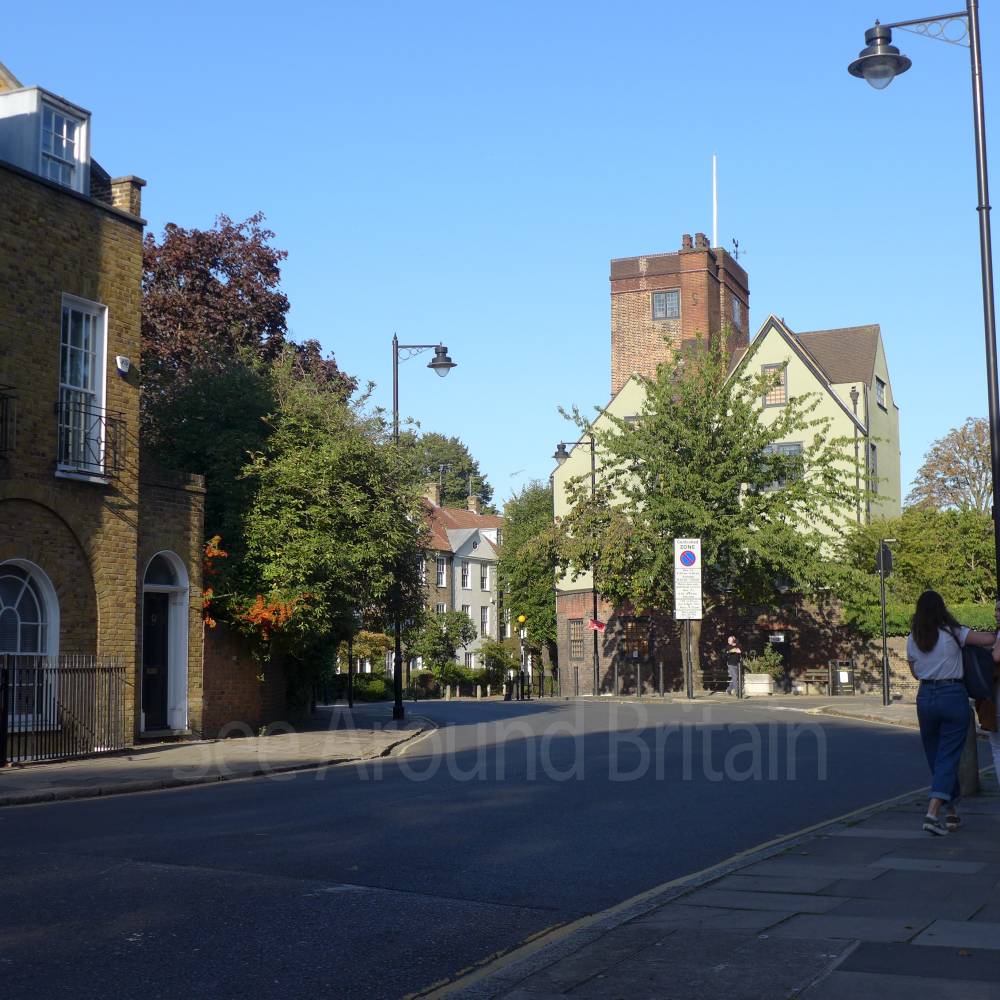
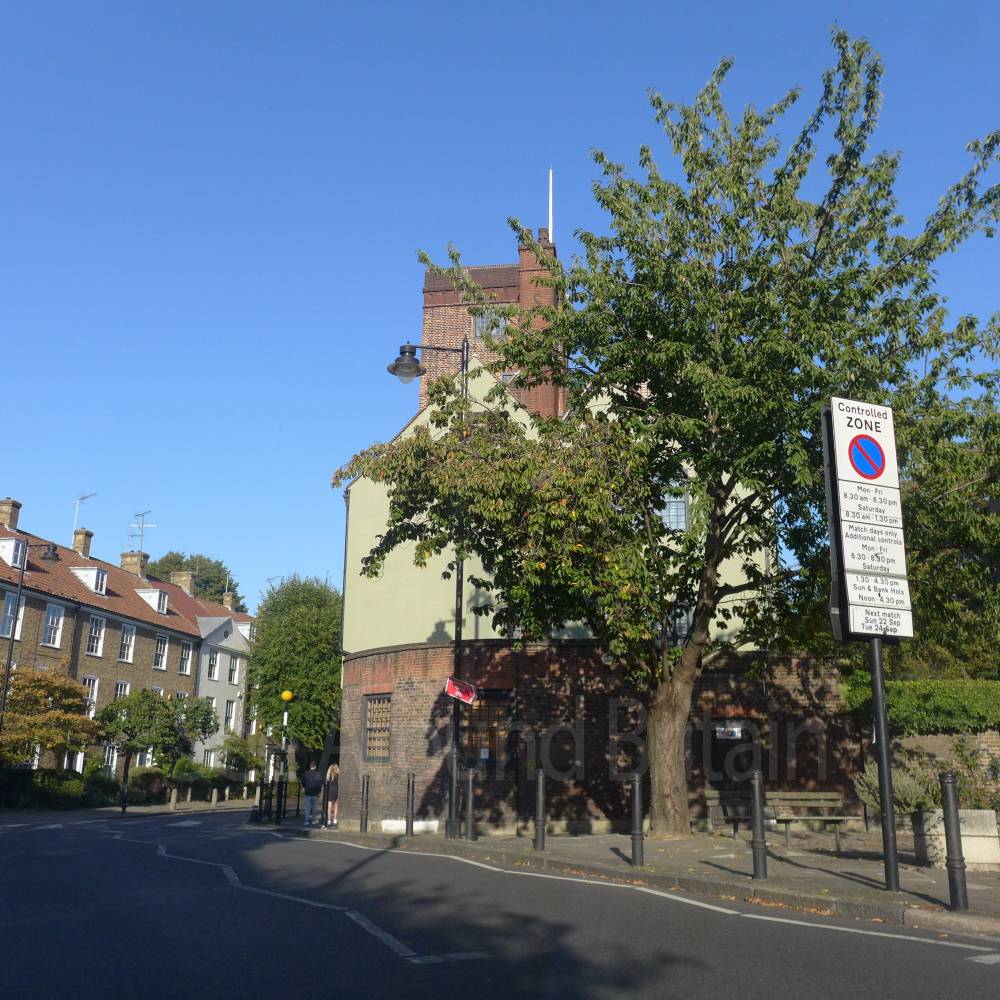
2025: "Canonbury House is the name given to several buildings in the Canonbury area of Islington, North London which once formed the manor house of Canonbury, erected for the Canons of St Bartholomew's Priory between 1509 and 1532. The remains today consist of Canonbury Tower and several buildings from the 1790s, some of which incorporate parts of the late 16th-century manor house. Today, the Tower and the other buildings, including a 1790s building today also named "Canonbury House", are arranged around the road named Canonbury Place.
Canonbury Tower is a Tudor tower and is the oldest building in Islington. It is the most substantial remaining part of the old manor house, and is a Grade II* listed building, located 100 metres (330 ft) east of Canonbury Square.
Canonbury House and Canonbury Tower have been owned or occupied by many noted historical figures, including Thomas Cromwell, John Dudley, Sir Francis Bacon, Oliver Goldsmith and Washington Irving.
Today's Canonbury House partially occupies, with Canonbury Tower, the site of the west range of Spencer's Old Canonbury House. It is a detached Grade II listed building bearing the name “Canonbury House” above its front door, and is a private residence. It dates to c. 1795, with the stone pedimented dormers added c. 1900. It was formerly known as St Stephen's Vicarage when it was the clergy house residence for St Stephen's Church, which is nearby on Canonbury Road.[67]
(based on Canonbury Tower: a Brief Guide):[81] Since 1998 the Tower has been used as a Masonic research centre.[82] It can occasionally be visited as part of a guided tour.
There is a tradition that Bacon planted the old red mulberry tree that still flourishes in the garden next to the Tower,[83] to encourage the home production of silk; however, silk worms prefer the white mulberry.[28]
The Tower is 66 feet (20 m) high and about 17 feet (5.2 m) square. The brick walls vary in thickness from 4 feet (1.2 m) to 2 feet 6 inches (0.76 m).[84] The main entrance hall leads into a low hall adjoining the Tower itself, and on the ground floor is a room with the original brickwork exposed

The room on the first floor commemorating the occupancy and work of Sir John Spencer is the plainer of the two panelled rooms. The chimneypiece is the most elaborate part, with lions' heads. At the top just below the ceiling there are three curious carved figures like the figurehead of a ship and there is another, which has lost its head, at eye level in the centre, just below a pair of bellows. There is strapwork ornament on the underside of the mantelpiece, and at either side Tudor roses in what might be garters prefigure or reflect the Rosicrucian interests of Sir Francis Bacon.[85] The same pattern is found on the upright pillars of the Great Bed of Ware. Twelve flat pilasters run from floor to ceiling.
By the end of the 16th century the Italian workmen who had come over to help Henry VIII on his various projects – the tomb of Henry VII and Greenwich and Whitehall Palaces – had mostly gone back and the workmanship is probably mainly Flemish.
Spencer Room:

The room on the first floor commemorating the occupancy and work of Sir John Spencer is the plainer of the two panelled rooms. The chimneypiece is the most elaborate part, with lions' heads. At the top just below the ceiling there are three curious carved figures like the figurehead of a ship and there is another, which has lost its head, at eye level in the centre, just below a pair of bellows. There is strapwork ornament on the underside of the mantelpiece, and at either side Tudor roses in what might be garters prefigure or reflect the Rosicrucian interests of Sir Francis Bacon.[85] The same pattern is found on the upright pillars of the Great Bed of Ware. Twelve flat pilasters run from floor to ceiling.
Compton Room:

On the second floor the panelling is more elaborate, of the type called "panel within panel", and there is liberal use of strapwork on the ten pilasters. The chimneypiece again is elaborate, with figures of Faith (one knee exposed, one arm missing) and Hope in a border of flowers and abstract pattern. The Latin inscribed beneath Faith – Fides Via Deus Meta – means "Faith is my way, God is my aim", and under Hope – Spes Certa Supra – means "My sure hope is above". The frieze over the fireplace consists of pomegranates and exotic fruits. Elsewhere it is a shell pattern, with at various intervals the arms of Spencer (argent two bars gemelle between three eagles displayed sable) and semi-grotesque heads. On the east side the panelling has been moved forward to provide another room, which contains bricked up a mullion window of the original type – replaced by windows of seasoned Oregon pine elsewhere in these rooms. The room is now all that remains of the occupancy of the Francis Bacon Society. Over the main door there is a carving known as a "cresting" incorporating a spread eagle."
Address
Canonbury Tower
6 Canonbury Place
London
N1 2NY
Phone
Website
https://www.londonpicturearchive.org.uk/view-item?i=78050&WINID=1764615140932
https://www.fbrt.org.uk/wp-content/uploads/2020/06/Canonbury_Place__Tower.pdf
https://britishlistedbuildings.co.uk/101280424-canonbury-tower-canonbury-ward
https://islingtonlife.london/discover-islington/local-history/islington-central-canonbury/
Directions
Opening Times
Always check with the venue directly for up-to-date information including opening times and admission charges as they may be subject to change
"Since 1998 the Tower has been used as a Masonic research centre.[82] It can occasionally be visited as part of a guided tour." See https://www.tripadvisor.co.uk/Attraction_Review-g186338-d19042575-Reviews-Canonbury_Tower-London_England.html
+ https://islingtonguidedwalks.com/old-walks/canonbury-tower-tours/
+ https://www.eventbrite.co.uk/e/canonbury-tower-tour-tickets-475150296327
Transport
Amenities
Travel Information
For further travel information please see: www.traveline.info
Or call Traveline on 0871 200 22 33
(Calls cost 12p per minute plus your phone company's access charge)
NB London ULTRA-LOW EMISSION ZONE
This started on 8 April 2019 in the Central London Congestion Charge Zone, and will extend to the whole of the London area within the
M25 Motorway from 25 October 2021.
For more details please see:
https://tfl.gov.uk/modes/driving/check-your-vehicle-35896
Vehicles registered with a 'disabled' or 'disabled passenger vehicles' tax class will benefit from a grace period after the ULEZ starts until 26 October 2025 as long as their vehicle doesn't change tax class, and this also applies to a 'disabled' vehicle registered outside the UK.
Location
Nearest Venues


Canonbury, Borough of Islington, London
144 metres*

Union Chapel, Compton Terrace, Islington, London
271 metres*


Compton Terrace Gardens, Islington, London
307 metres*

*Distances are calculated in a straight line from the current venue, please allow extra time/distance based on available paths or roads.