

Montevideo, Uruguay’s capital, South America
Details
Accessibility
https://montevideo.gub.uy/area-tematica/inclusion-social/personas-con-discapacidad
Brief description
https://en.wikipedia.org/wiki/Montevideo#
_(cropped).jpg)


.jpeg)

2026: "Montevideo (/ˌmɒntɪvɪˈdeɪoʊ/,[11] US also /-ˈvɪdioʊ/;[12] Spanish: [monteβiˈðeo] ⓘ) is the capital and largest city of Uruguay. According to the 2023 census, the city proper has a population of 1,302,954 (about 37.2% of the country's total population)[13] in an area of 201 square kilometers (78 sq mi). Montevideo is situated on the southern coast of the country, on the northeastern bank of the Río de la Plata.
A Portuguese garrison was established in the place where today is the city of Montevideo in November 1723. The Portuguese garrison was expelled in February 1724 by a Spanish soldier, Bruno Mauricio de Zabala, as a strategic move amidst the Spanish-Portuguese dispute over the platine region. There is no official document establishing the foundation of the city, but the "Diario" of Bruno Mauricio de Zabala officially mentions the date of 24 December 1726 as the foundation, corroborated by presential witnesses. The complete independence from Buenos Aires as a real city was not reached until 1 January 1730. It was also under brief British rule in 1807, but eventually the city was retaken by Spanish criollos who defeated the British invasions of the River Plate. Montevideo is the seat of the administrative headquarters of Mercosur and ALADI, Latin America's leading trade blocs, a position that entailed comparisons to the role of Brussels in Europe.[14]
The 2019 Mercer's report on quality of life rated Montevideo first in Latin America,[15] a rank the city has consistently held since 2005.[16][17][18][19][20] As of 2010, Montevideo was the 19th largest city economy in the continent and 9th highest income earner among major cities.[21] In 2022, it has a projected GDP of $53.9 billion, with a per capita of $30,148.[22] In 2018, it was classified as a beta global city ranking eighth in Latin America and 84th in the world.[23] Montevideo hosted every match during the first FIFA World Cup in 1930. Described as a "vibrant, eclectic place with a rich cultural life",[24] and "a thriving tech center and entrepreneurial culture",[19] Montevideo ranked eighth in Latin America on the 2013 MasterCard Global Destination Cities Index.[25]
The city features historic European architecture,[26] and is considered one of the cities with the most art deco influence.[27] It is the hub of commerce and higher education in Uruguay as well as its chief port and financial hub, anchoring the metropolitan area with a population of around 2 million.
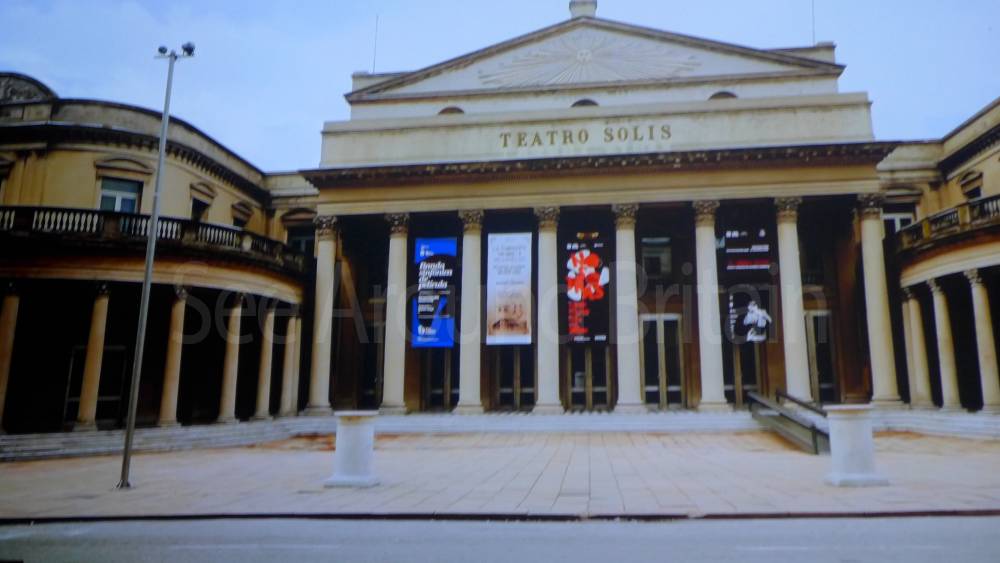
Montevideo has a very rich architectural heritage and a number of writers, artists, and musicians. Uruguayan tango is a unique form of dance that originated in the neighborhoods of Montevideo towards the end of the 1800s. Tango, candombe and murga are the three main styles of music in this city. The city is also the center of the cinema of Uruguay, which includes commercial, documentary and experimental films. There are two movie theater companies running seven cinemas,[140][141] around ten independent ones[142] and four art film cinemas in the city.[143] The theater of Uruguay is admired inside and outside Uruguayan borders. The Solís Theatre is the most prominent theater in Uruguay and the oldest in South America.[144] There are several notable theatrical companies and thousands of professional actors and amateurs. Montevideo playwrights produce dozens of works each year; of major note are Mauricio Rosencof, Ana Magnabosco [es] and Ricardo Prieto [es]. "
Address
Football Museum
4R4X+9CC
Av. Dr. Américo Ricaldoni
11600 Montevideo, Departamento de Montevideo
Uruguay
+ Montevideo Municipality, Headquarters Building:
Av. 18 de Julio 1360 - CP 11200, Montevideo - Uruguay
Telephone support: 1950
Monday to Friday from 8:00 a.m. to 7:00 p.m., Saturdays from 8:00 a.m. to 2:00 p.m.
WhatsApp support: 099 019500
Phone
Website
https://www.montevideo.gub.uy/
https://www.facebook.com/montevideoIM/
Directions
Opening Times
Always check with the venue directly for up-to-date information including opening times and admission charges as they may be subject to change
Transport
https://en.wikipedia.org/wiki/Montevideo#Transport
2026 "The city and its metropolitan area have a bus transportation network, the Sistema Mets acronym. It covers urban and interurban services within the Metropolitan Area and is administered by the municipal government together with the Ministry of Transport and Public Works. The Baltasar Brum Terminal located in Ciudad Vieja, is the main urban bus station.[223] However, there are numerous interchanges and terminals distributed in both the city and the metropolitan area.
Taxis
 Taxis of Montevideo.
The livery of most Montevideo taxis features white on the sides, along with a yellow band, as well as yellow on the top of the car. To determine the rate they use a taximeter, which will determine the price depending on the distance traveled. All taxis accept cash, although it is also common that a passenger can pay with a credit card.[224]
Rail
The State Railways Administration of Uruguay (AFE) operates three commuter rail lines, namely the Empalme Olmos, San Jose and Florida. These lines operate to major suburban areas of Canelones, San José and Florida. Within the Montevideo city limits, local trains stop at Lorenzo Carnelli, Yatai (Step Mill), Sayago, Colón (line to San Jose and Florida), Peñarol and Manga (line Empalme Olmos) stations. The historic 19th century General Artigas Central Station located in the barrio Aguada, six blocks from the central business district, was abandoned 1 March 2003 and remains closed.[225][226] A new station, 500 meters (1,600 ft) north of the old one and part of the Telecommunications Tower modern complex, has taken over the rail traffic.[227]
The train service is currently suspended for works related to the modernization of the railway system until mid-2023 when the work will end.[14][24][needs update]
Intercity buses
The Tres Cruces bus station is the main bus terminal in Uruguay, serving long-distance buses that travel into Montevideo, from other parts of the country and abroad. Inaugurated in 1994, it serves more than 12 million passengers per year.[228][229]
 Carrasco International Airport
Companies operating at Tres Cruces bus station: Agencia central, Bruno, Copsa, Cromin, Cynsa, Copay, Cot, Cut, Corporacion, Cita, Cauvi, Colonia Express, El Condor, El Norteño, Ega, Expreso Chago, Expreso Minuano, Intertur, Nossar, Nuñez, Rutas del sol, TTL, Turil, Turismar, etc.
Aviation
Montevideo is served by the Carrasco International Airport (IATA: MVD, ICAO: SUMU), which is located in the north of Ciudad de la Costa, in Canelones Department, 19 km (12 mi) from the city center. It handles over 1,5 million passengers per year,[230][231] and has been cited as one of the most efficient and traveler-friendly airports in Latin America.[232]
Ángel S. Adami Airport is a private airport operated by minor charter companies and in which there is also a flight school.[233]
Port
 Buquebus high-speed ferries connect Montevideo to Argentina
Montevideo is also served by a ferry system operated by the company Buquebus that connects the port with Buenos Aires. More than 2.2 million people per year travel between Argentina and Uruguay with Buquebus. One of these ships is a catamaran, which can reach a top speed of about 80 km/h (50 mph).[234]
 Port of Montevideo
The port on Montevideo Bay is one of the reasons the city was founded. It gives natural protection to ships, although two jetties now further protect the harbor entrance from waves. This natural port is competitive with the other great port of Río de la Plata, Buenos Aires.[235]
The main engineering work on the port occurred between the years 1870 and 1930. These six decades saw the construction of the port's first wooden pier, several warehouses in La Aguada, the north and south Rambla, a river port, a new pier, the dredged river basin and the La Teja Refinery. A major storm in 1923 necessitated repairs to many of the city's engineering works.[49] Since the second half of the 20th century, until the 21st century, physical changes had ceased, and since that time the area had degraded due to national economic stagnation.[49]
The port's proximity has contributed to the installation of various industries in the area surrounding the bay, particularly import/export businesses and other business related to port and naval activity. The density of industrial development in the area surrounding the port has kept its popularity as a residential area relatively low despite its centrality. The main environmental problems are subaquatic sedimentation and air and water contamination.[49]
Every year more than one hundred cruises arrive, bringing tourists to Montevideo by public or private tours.[236]
Amenities
https://en.wikipedia.org/wiki/Montevideo#Museums
2026: "The Centro Cultural de España, as well as Asturian and cultural centers, testify to Montevideo's considerable Spanish heritage. Montevideo also has important museums including Museo Torres García,[165] Museo José Gurvich [es], Museo Nacional de Artes Visuales and Museo Juan Manuel Blanes etc.
The Montevideo Cabildo was the seat of government during the colonial times of the Viceroyalty of the Río de la Plata. It is located in front of Constitution Square, in Ciudad Vieja.[78] Built between 1804 and 1869 in Neoclassical style, with a series of Doric and Ionic columns, it became a National Heritage Site in 1975. In 1958, the Municipal Historic Museum and Archive was inaugurated here. It features three permanent city museum exhibitions, as well as temporary art exhibitions, cultural events, seminars, symposiums and forums.[166]
 Uruguayan officials conversing at a meeting at the Palacio Taranco, 6 November 2010
The Palacio Taranco is located in front of the Plaza Zabala, in the heart of Ciudad Vieja. It was erected in the early 20th century as the residence of the Ortiz Taranco brothers on the ruins of Montevideo's first theater (of 1793), during a period in which the architectural style was influenced by French architecture. The palace was designed by French architects Charles Louis Girault and Jules-Léon Chifflot [fr] who also designed the Petit Palais and the Arc de Triomphe in Paris. It passed to the city from the heirs of the Tarancos in 1943, along with its precious collection of Uruguayan furniture and draperies and was deemed by the city as an ideal place for a museum; in 1972 it became the Museum of Decorative Arts of Montevideo and in 1975 it became a National Heritage Site.[167][168] The Decorative Arts Museum has an important collection of European paintings and decorative arts, ancient Greek and Roman art and Islamic ceramics of the 10th–18th century from the area of present-day Iran.[145] The palace is often used as a meeting place by the Uruguayan government.
 Museo Historico Nacional de Montevideo
The National History Museum of Montevideo is located in the historical residence of General Fructuoso Rivera. It exhibits artifacts related to the history of Uruguay.[78] In a process begun in 1998, the National Museum of Natural History (1837) and the National Museum of Anthropology (1981), merged in 2001, becoming the National Museum of Natural History and Anthropology. In July 2009, the two institutions again became independent.[169] The Historical Museum has annexed eight historical houses in the city, five of which are located in the Ciudad Vieja. One of them, on the same block with the main building, is the historic residence of Antonio Montero, which houses the Museo Romantico.[170] Also nearby is the Museo Casa de José Garibaldi where Giuseppe Garibaldi lived in the 1840s while participating in the Uruguayan Civil War.[171]
 Museo Torres García
The Museo Torres García is located in the Old Town, and exhibits Joaquín Torres García's unusual portraits of historical icons and cubist paintings akin to those of Picasso and Braque.[172] The museum was established by Manolita Piña Torres, the widow of Torres Garcia, after his death in 1949. She also set up the García Torres Foundation, a private non-profit organization that organizes the paintings, drawings, original writings, archives, objects and furniture designed by the painter as well as the photographs, magazines and publications related to him.[173]
 Museo Naval de Montevideo
There are several other important art museums in Montevideo. The Centro de Fotografía de Montevideo (CdF) is a museum, archive, and gallery for historic and contemporary photography with twelve outdoor exhibition spaces in various Montevideo neighborhoods as well as four galleries in its downtown headquarters. The National Museum of Visual Arts in Parque Rodó has Uruguay's largest collection of paintings.[81][145] The Juan Manuel Blanes Museum was founded in 1930, the 100th anniversary of the first Constitution of Uruguay, significant with regard to the fact that Juan Manuel Blanes painted Uruguayan patriotic themes. In the back of the museum is a Japanese Garden with a pond where there are over a hundred carp.[174] The Museo de Historia del Arte, located in the Palacio Municipal, features replicas of ancient monuments and exhibits a varied collection of artifacts from Egypt, Mesopotamia, Persia, Greece, Rome and Native American cultures including local finds of the pre-Columbian period.[175] The Museo Municipal Precolombino y Colonial, in the Ciudad Vieja, has preserved collections of the archeological finds from excavations carried out by Uruguayan archeologist Antonio Taddei. These antiquaries are exhibits of pre-Columbian art of Latin America, painting and sculpture from the 17th and 18th century mostly from Mexico, Peru and Brazil.[145] The Museo de Arte Contempo has small exhibits of modern Uruguayan painting and sculpture.[81]
There are also other types of museums in the city. The Museo del Gaucho y de la Moneda, located in the Centro, has distinctive displays of the historical culture of Uruguay's gauchos, their horse gear, silver work and mate (tea), gourds, and bombillas (drinking straws) in odd designs.[81] The Museo Naval, is located on the eastern waterfront in Buceo and offers exhibits depicting the maritime history of Uruguay.[81] The Museo del Automóvil, belonging to the Automobile Club of Uruguay, has a rich collection of vintage cars which includes a 1910 Hupmobile.[176] The Museo y Parque Fernando García in Carrasco, a transport and automobile museum, includes old horse carriages and some early automobiles.[177] The Castillo Pittamiglio, with an unusual façade, highlights the eccentric legacy of Humberto Pittamiglio, local alchemist and architect.[81]
 Carnival drummers.
 Carnival dancer and drummers.
As the capital of Uruguay, Montevideo is home to a number of festivals and carnivals including a Gaucho festival when people ride through the streets on horseback in traditional gaucho gear. The major annual festival is the annual Montevideo Carnival which is part of the national festival of Carnival Week, celebrated throughout Uruguay, with central activities in the capital, Montevideo. Officially, the public holiday lasts for two days on Carnival Monday and Shrove Tuesday preceding Ash Wednesday, but due to the prominence of the festival, most shops and businesses close for the entire week.[178] During carnival there are many open-air stage performances and competitions and the streets and houses are vibrantly decorated. "Tablados" or popular scenes, both fixed and movable, are erected in the whole city.[178] Notable displays include "Desfile de las Llamadas" ("Parade of the Calls"), which is a grand united parade held on the south part of downtown, where it used to be a common ritual back in the early 20th century.[178] Due to the scale of the festival, preparation begins as early as December with an election of the "zonal beauty queens" to appear in the carnival.[178]