

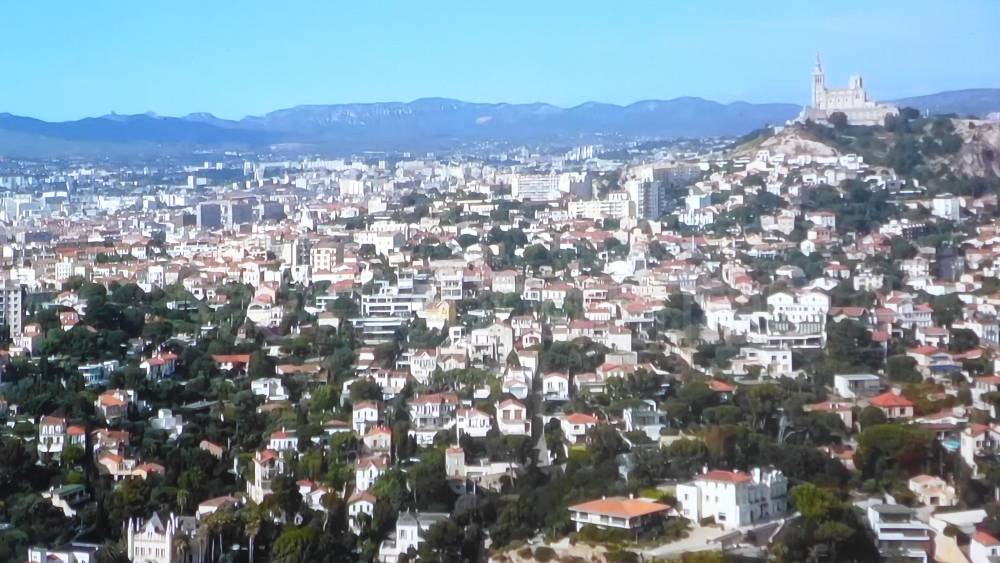
Marseille, a port city in southern France, Europe
Details
Accessibility
https://app.acce-o.fr/client/marseille
https://www.marseille.fr/2024-olympic-games-discover-programme-cultural-olympiad
Brief description
https://en.wikipedia.org/wiki/Marseille


Notre-Dame de la Garde 2025: https://en.wikipedia.org/wiki/Notre-Dame_de_la_Garde
2025: "Marseille[a] (Provençal Occitan: Marselha; see below) is a city in southern France, the prefecture of the department of Bouches-du-Rhône and of the Provence-Alpes-Côte d'Azur region. Situated in the Provence region, it is located on the coast of the Mediterranean Sea, near the mouth of the Rhône river. Marseille is the second-most populous city in France, after Paris, with 877,215 inhabitants in 2022 (Jan. census)[9] over a municipal territory of 241 km2 (93 sq mi). Together with its suburbs and exurbs, the Marseille metropolitan area, which extends over 3,972 km2 (1,534 sq mi), had a population of 1,900,957 at the Jan. 2022 census.[5] The cities of Marseille, Aix-en-Provence, and 90 suburban municipalities have formed since 2016 the Aix-Marseille-Provence Metropolis, an indirectly elected metropolitan authority now in charge of wider metropolitan issues, with a population of 1,922,626 at the Jan. 2022 census.[10]
In the 1990s, the Euroméditerranée project for economic development and urban renewal was launched. New infrastructure projects and renovations were carried out in the 2000s and 2010s: the tramway, the renovation of the Hôtel-Dieu into a luxury hotel, the expansion of the Velodrome Stadium, the CMA CGM Tower, as well as other quayside museums such as the Museum of Civilisations of Europe and the Mediterranean (MuCEM). As a result, Marseille now has the most museums in France after Paris. The city was named European Capital of Culture in 2013 and European Capital of Sport in 2017. Home of the association football club Olympique de Marseille, one of the most successful and widely supported clubs in France, Marseille has also hosted matches at the 1998 World Cup and Euro 2016. It is also home to several higher education institutions in the region, including the University of Aix-Marseille. A resident of Marseille is a Marseillais."
Address
Notre-Dame de la Garde 2025: https://en.wikipedia.org/wiki/Notre-Dame_de_la_Garde
Domaine Notre Dame de la Garde
Rue Fort du Sanctuaire
13006 Marseille
France
For any information or documentation requests:
information@marseille-tourisme.com
Phone
2025: "Marseille Tourist, Leisure and Convention Bureau
11 La Canebière - CS 60340
13211 Marseille cedex 01
Open every day from 9am to 6pm (except 25/12 and 01/01)
Website
https://www.marseille-tourisme.com/
https://www.facebook.com/choosemarseille/
Directions
Opening Times
Always check with the venue directly for up-to-date information including opening times and admission charges as they may be subject to change
2025: "Marseille Tourist, Leisure and Convention Bureau
11 La Canebière - CS 60340
13211 Marseille cedex 01
Open every day from 9am to 6pm (except 25/12 and 01/01)
Transport
https://en.wikipedia.org/wiki/Marseille#Transport
Amenities
https://en.wikipedia.org/wiki/Marseille_Cathedral


2025: "Marseille Cathedral (French: Cathédrale Sainte-Marie-Majeure de Marseille [katedʁal sɛ̃t maʁi maʒœʁ də maʁsɛj] or Cathédrale de La Major or simply La Major; Occitan: Catedrala Santa Maria Majora de Marselha) is a Roman Catholic cathedral and a national monument of France. Located in Marseille, it has been a basilica minor since 1896. It is the seat of the Archdiocese of Marseille (the Diocese of Marseille until its elevation in 1948).
- This cathedral should not be confused with the more famous basilica of Notre-Dame de la Garde, also in Marseille."
https://www.marseille-tourisme.com/en/discover-marseille/culture-heritage/discover-the-sites-and-monuments-in-marseille/cathedrale-de-la-major-marseilles-cathedral/ Place de la Major, 13002 Marseille, France
https://en.wikipedia.org/wiki/Marseille#Culture
2025: "Marseille is a city that has its own unique culture and is proud of its differences from the rest of France.[65] Today it is a regional centre for culture and entertainment with an important opera house, historical and maritime museums, five art galleries and numerous cinemas, clubs, bars and restaurants.
Marseille has a large number of theatres, including La Criée, Le Gymnase and the Théâtre Toursky. There is also an extensive arts centre in La Friche, a former match factory behind the Saint-Charles station. The Alcazar, until the 1960s a well known music hall and variety theatre, has recently been completely remodelled behind its original façade and now houses the central municipal library.[66] Other music venues in Marseille include Le Silo (also a theatre) and GRIM.
Marseille has also been important in the arts. It has been the birthplace and home of many French writers and poets, including Victor Gélu (fr), Valère Bernard, Pierre Bertas,[67] Edmond Rostand and André Roussin. The small port of l'Estaque on the far end of the Bay of Marseille became a favourite haunt for artists, including Auguste Renoir, Paul Cézanne (who frequently visited from his home in Aix), Georges Braque and Raoul Dufy.
.jpg) The Opéra de Marseille
The Opéra de MarseilleMarseille's main cultural attraction was, since its creation at the end of the 18th century and until the late 1970s, the Opéra. Located near the Old Port and the Canebière, at the very heart of the city, its architectural style was comparable to the classical trend found in other opera houses built at the same time in Lyon and Bordeaux. In 1919, a fire almost completely destroyed the house, leaving only the stone colonnade and peristyle from the original façade.[83][84] The classical façade was restored and the opera house reconstructed in a predominantly Art Deco style, as the result of a major competition. Currently the Opéra de Marseille stages six or seven operas each year.[85]
Since 1972, the Ballet national de Marseille has performed at the opera house; its director from its foundation to 1998 was Roland Petit.
Marseille is listed as a major centre of art and history. The city has many museums and galleries and there are many ancient buildings and churches of historical interest.
Central Marseille
_(14181557102).jpg) Le Panier quarter with the Hotel de Ville and the church of Notre-Dame des Accoules
Le Panier quarter with the Hotel de Ville and the church of Notre-Dame des Accoules_(14177078901).jpg) La Vieille Charité
La Vieille Charité The Abbey of St. Victor and the basilica of Notre-Dame de la Garde
Most of the attractions of Marseille (including shopping areas) are located in the 1st, 2nd, 6th and 7th arrondissements. These include:[101][102]
- The Old Port or Vieux-Port, the main harbour and marina of the city. It is guarded by two massive forts (Fort Saint-Nicolas and Fort Saint-Jean) and is one of the main places to eat in the city. Dozens of cafés line the waterfront. The Quai des Belges at the end of the harbour is the site of the daily fish market. Much of the northern quayside area was rebuilt by the architect Fernand Pouillon after its destruction by the Nazis in 1943.
- The Hôtel de Ville (City Hall), a baroque building dating from the 17th century.
- The Centre Bourse and the adjacent Rue St Ferreol district (including Rue de Rome and Rue Paradis), the main shopping area in central Marseille.
- The Porte d'Aix, a triumphal arch commemorating French victories in the Spanish Expedition.
- The Hôtel-Dieu, a former hospital in Le Panier, transformed into an InterContinental hotel in 2013.
- La Vieille Charité in Le Panier, an architecturally significant building designed by the Puget brothers. The central baroque chapel is situated in a courtyard lined with arcaded galleries. Originally built as an alms house, it is now home to an archeological museum and a gallery of African and Asian art, as well as bookshops and a café. It also houses the Marseille International Poetry Centre.[103]
- The Cathedral of Sainte-Marie-Majeure or La Major, founded in the fourth century, enlarged in the 11th century and completely rebuilt in the second half of the 19th century by the architects Léon Vaudoyer and Henri-Jacques Espérandieu. The present day cathedral is a gigantic edifice in Romano-Byzantine style. A romanesque transept, choir and altar survive from the older medieval cathedral, spared from complete destruction only as a result of public protests at the time.
- The 12th-century parish church of Saint-Laurent and adjoining 17th-century chapel of Sainte-Catherine, on the quayside near the cathedral.
- The Abbey of Saint-Victor, one of the oldest places of Christian worship in Europe. Its fifth-century crypt and catacombs occupy the site of a Hellenic burial ground, later used for Christian martyrs and venerated ever since. Continuing a medieval tradition,[104] every year at Candlemas a Black Madonna from the crypt is carried in procession along Rue Sainte for a blessing from the archbishop, followed by a mass and the distribution of "navettes" and green votive candles.
Museums
In addition to the two in the Centre de la Vieille Charité, described above, the main museums are:[105]
- The Musée des Civilisations de l'Europe et de la Méditerranée (MuCEM) and the Villa Méditerranée were inaugurated in 2013. The MuCEM is devoted to the history and culture of European and Mediterranean civilisations. The adjacent Villa Méditerranée, an international centre for cultural and artistic interchange, is partially constructed underwater. The site is linked by footbridges to the Fort Saint-Jean and to the Panier.[106][107]
- The Musée Regards de Provence, opened in 2013, is located between the Cathedral of Notre Dame de la Majeur and the Fort Saint-Jean. It occupies a converted port building constructed in 1945 to monitor and control potential sea-borne health hazards, in particular epidemics. It now houses a permanent collection of historical artworks from Provence as well as temporary exhibitions.[108]
- The Musée des Docks Romains preserves in situ the remains of Roman commercial warehouses, and has a small collection of objects, dating from the Greek period to the Middle Ages, that were uncovered on the site or retrieved from shipwrecks.
- The Marseille History Museum (Musée d'Histoire de Marseille), devoted to the history of the town, located in the Centre Bourse. It contains remains of the Greek, and Roman history of Marseille as well as the best preserved hull of a sixth-century boat in the world. Ancient remains from the Hellenic port are displayed in the adjacent archeological gardens, the Jardin des Vestiges.
- The Musée Cantini, a museum of modern art near the Palais de Justice. It houses artworks associated with Marseille as well as several works by Picasso.
- The Musée Grobet-Labadié, opposite the Palais Longchamp, houses an exceptional collection of European objets d'art and old musical instruments.
- The 19th-century Palais Longchamp, designed by Esperandieu, is located in the Parc Longchamp. Built on a grand scale, this italianate colonnaded building rises up behind a vast monumental fountain with cascading waterfalls. The jeux d'eau marks and masks the entry point of the Canal de Provence into Marseille. Its two wings house the Musée des beaux-arts de Marseille (a fine arts museum), and the Natural History Museum (Muséum d'histoire naturelle de Marseille).
- The Château Borély is located in the Parc Borély, a park off the Bay of Marseille with the Jardin botanique E.M. Heckel, a botanical garden. The Museum of the Decorative Arts, Fashion and Ceramics opened in the renovated château in June 2013.[109]
- The Musée d'Art Contemporain de Marseille (fr) (MAC), a museum of contemporary art, opened in 1994. It is devoted to American and European art from the 1960s to the present day.[110]
- The Musée du Terroir Marseillais (fr) in Château-Gombert, devoted to Provençal crafts and traditions.[111]
 The MuCEM, Musée Regards de Provence and Villa Mediterannée, with Notre Dame de la Majeur on the right
 The sixteenth century Maison Diamantée now houses municipal offices
 The music room in the Grobet-Labadié museum
 The Palais Longchamp with its monumental fountain"

.jpg)


Location
Nearest Venues
85.16 miles*
99.33 miles*
*Distances are calculated in a straight line from the current venue, please allow extra time/distance based on available paths or roads.