

Pompeii was a prosperous ancient Roman city near Naples, Italy
Details
Accessibility
https://pompeiisites.org/info-per-la-visita/pompei-per-tutti/
"The Archaeological Park of Pompeii, in line with the principles set out in the United Nations Convention on the Rights of Persons with Disabilities regarding the right of access to culture, in addition to ensuring the protection and conservation of the cultural heritage entrusted to it, is committed to contributing to its valorization and to guaranteeing the widest possible enjoyment by the entire public through all actions aimed at ensuring the best conditions of use also by people with disabilities, in order to promote an inclusive development of culture.
In order to allow physical accessibility to cultural sites, the Park aims to promote easy routes for people with mobility difficulties and to promote specific initiatives for visitors with disabilities.
Accessibility Office Contact : Arch. Arianna Spinosa
For an accessible visit contact:
Information Office: +39 081 8575 347 + pompei.info@cultura.gov.it "
Brief description
https://en.wikipedia.org/wiki/Pompeii#


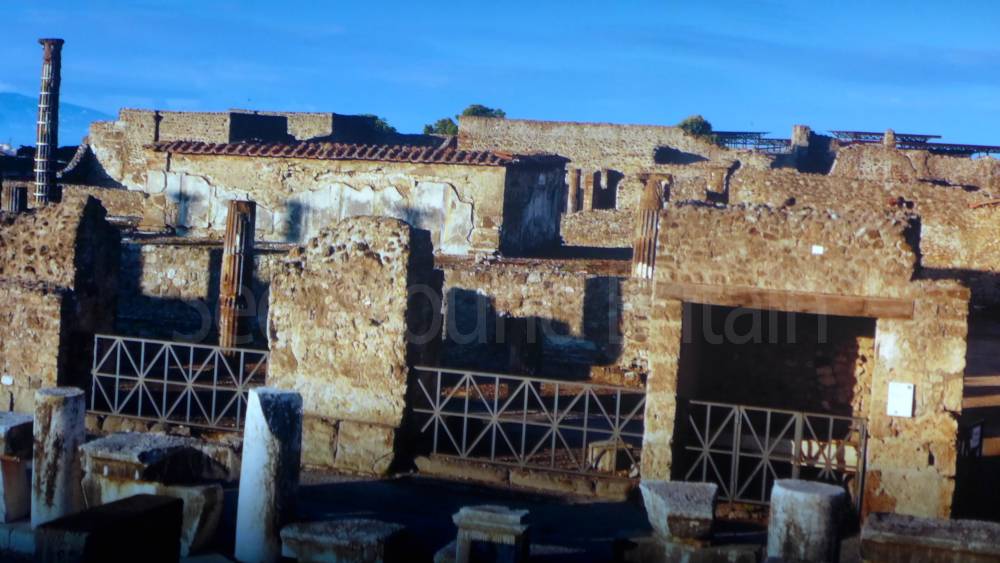
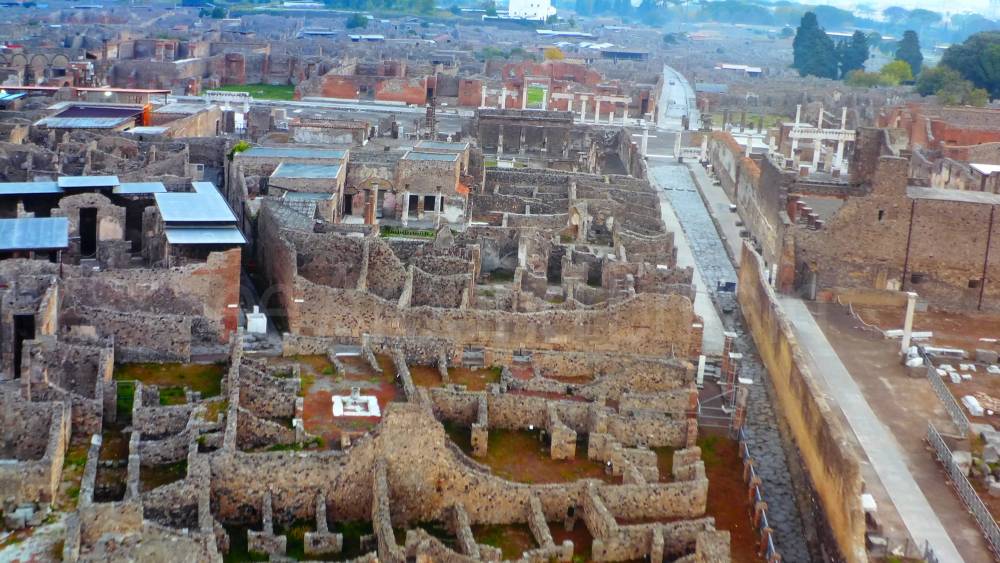
The Forum of Pompeii with the entrances to the Basilica (left) and Macellum (right), the Temple of Jupiter (front) and Mount Vesuvius in the distance
2026: "Pompeii (/pɒmˈpeɪ(i)/ ⓘ pom-PAY(-ee); Latin: [pɔmˈpei̯.iː]) was a city in what is now the municipality of Pompei, near Naples, in the Campania region of Italy. Along with Herculaneum, Stabiae, and many surrounding villas, the city was buried under 4 to 6 m (13 to 20 ft) of volcanic ash and pumice in the eruption of Mount Vesuvius in 79 AD.
Largely preserved under the ash, Pompeii offers a unique snapshot of Roman life, frozen at the moment it was buried,[1] as well as insight into ancient urban planning.[2][3] It was a wealthy town of 10,000 to 20,000 residents at the time it was destroyed.[4] It hosted many fine public buildings and luxurious private houses with lavish decorations, furnishings and artworks, which were the main attractions for early excavators; subsequent excavations have found hundreds of private homes and businesses reflecting various architectural styles and social classes, as well as numerous public buildings. Organic remains, including wooden objects and human bodies, were interred in the ash; their eventual decay allowed archaeologists to create moulds of figures in their final moments of life. The numerous graffiti carved on outside walls and inside rooms provide a wealth of examples of the largely lost Vulgar Latin spoken colloquially at the time, contrasting with the formal language of classical writers.
Following its destruction, Pompeii remained largely undisturbed until its rediscovery in the late 16th century. Major excavations did not begin until the mid-18th century, which marked the emergence of modern archaeology;[5] initial efforts to unearth the city were haphazard or marred by looting, resulting in many items or sites being damaged or destroyed.[6] By 1960, most of Pompeii had been uncovered but left in decay;[7] further major excavations were banned or limited to targeted, prioritised areas. Since 2018, these efforts have led to new discoveries in some previously unexplored areas of the city.[8][9][10][11]
Pompeii is a UNESCO World Heritage Site, owing to its status as "the only archaeological site in the world that provides a complete picture of an ancient Roman city."[12] It is among the most popular tourist attractions in Italy, with approximately 2.5 million visitors annually.[13][14] "
This venue can get very crowded, so another notable possible less crowded venue to visit is https://en.wikipedia.org/wiki/Herculaneum#


2026: "Herculaneum[a] is an ancient Roman town located in the modern-day comune of Ercolano, Campania, Italy. Herculaneum was buried under a massive pyroclastic flow in the eruption of Mount Vesuvius in 79 AD. See https://www.herculaneum.org/ hcp@herculaneum.org
Like the nearby city of Pompeii, Herculaneum is famous as one of the few ancient cities to be preserved nearly intact, as the solidified material from the volcano that blanketed the town protected it against looting and the elements. Although less known than Pompeii today, it was the first and, for a long time, the only discovered Vesuvian city (in 1709). Pompeii was revealed in 1748 and identified in 1763.[1] Unlike Pompeii, the mainly pyroclastic material that covered Herculaneum carbonized and preserved more wooden objects such as roofs, beds, and doors, as well as other organic-based materials such as food and papyrus.
According to the traditional tale, the city was rediscovered by chance in 1709 during the drilling of a well. Remnants of the city, however, were already found during earlier earthworks.[2] In the years following the site's uncovering, treasure seekers excavated tunnels and took artifacts. Regular excavations commenced in 1738 and have continued irregularly since. Today, only a fraction of the ancient site has been excavated. The focus has shifted to preserving the already-excavated portions of the city rather than exposing more.
Smaller than Pompeii with a population of circa 5,000,[3] Herculaneum was a wealthier town.[4] It was a seaside retreat for the Roman elite, as reflected by the extraordinary density of luxurious houses featuring lavish use of coloured marble cladding. Buildings of the ancient city include the Villa of the Papyri and the so-called "boat houses", wherein the skeletal remains of at least 300 people were found."
Address
Antiquarium di Pompei
80045 Pompei NA
Italy
Information for visitors: pompei.info@cultura.gov.it
Info: +39 081 8575 347
Management and Administrative Offices – Via Plinio n. 26
Office Switchboard +39 081 8575 111
80045 Pompeii (Naples)
Phone
Website
Directions
https://pompeiisites.org/info-per-la-visita/dove-siamo-e-come-raggiungerci/
By car:
- A3 Naples-Salerno motorway (Pompeii Scavi exit)
Opening Times
Always check with the venue directly for up-to-date information including opening times and admission charges as they may be subject to change
See https://pompeiisites.org/info-per-la-visita/orari-e-tariffe/
Transport
https://pompeiisites.org/info-per-la-visita/dove-siamo-e-come-raggiungerci/
2026: By train:
- Porta Marina, Piazza Esedra: Naples-Sorrento Circumvesuviana (Pompeii Villa dei Misteri stop)
- Piazza Anfiteatro: Circumvesuviana Naples-Poggiomarino (Pompei Santuario stop)
- Naples-Salerno FS train (Pompei stop)
Bus:
- SITA from Naples and Salerno
- BUSITALIA Campania n. 4 from Salerno
- BUSITALIA Campania n. 50 express train from Salerno (via motorway)
Amenities
See https://www.pompeiichildrensmuseum.it/
Location
Nearest Venues
14.20 miles*
*Distances are calculated in a straight line from the current venue, please allow extra time/distance based on available paths or roads.