

St Woolos Cathedral, Stow Hill, Newport. Open Daily. Free Admission.


Details
Accessibility
On-road parking is available all around the Cathedral, mostly made up of limited 2-hour waiting.
There is a steep ramp on the Stow Hill Road side to get to the main church gate.
Level access to the gate is available from the front.
A side entrance is available for wheelchair access to the Cathedral.
The inside surface is mainly of stone slabs which maybe uneven.
There are steps to access different parts of the building, but the main area is level.
A ramp is available to access the toilet facilities.
Brief description
12th Century Cathedral of the Diocese of Monmouth, originally built as a Parish Church, with additions later in its history; it became a Cathedral in 1921.
https://en.wikipedia.org/wiki/Newport_Cathedral

2025: "Newport Cathedral (Welsh: Eglwys Gaderiol Casnewydd/Cadeirlan Casnewydd), also known as St Gwynllyw's or St Woolos' Cathedral, is the cathedral of the Diocese of Monmouth within the Church in Wales, and the seat of the Bishop of Monmouth.[a] Its official title is Newport Cathedral Church of St Woolos, King and Confessor.[1] The English name, Woolos, is an anglicisation of the Welsh name Gwynllyw.[2]: 280
It became a cathedral in 1949 and while it is the size of a large parish church rather than a typical cathedral, its history and development from the sixth to the twentieth century make it arguably one of the most interesting religious buildings in Wales.[3]: 159
The cathedral is usually approached from the west door, so the visitor moves from the west towards the east end, passing through the tower, then St Mary's chapel and through the Romanesque portal to the larger church beyond and finally to the twentieth-century eastern extensions.
To enter St Mary's chapel, which now links the tower with the main body of the cathedral, we pass through a modern glass screen engraved with representations of St Gwynllyw holding his church and of St David (Welsh: Dewi Sant), the patron saint of Wales, with a dove on his shoulder.
St Mary's was the original site of Gwynllyw’s church, (though much restored and rebuilt in the 11th, 13th and 19th centuries) and the site of his tomb, (Welsh: bedd y sant), which is believed to have been on the south side of the building.[9] This chapel is a place to savour the established tradition of Celtic Christianity in Wales, which long predates the arrival of St Augustine to convert England.
Towards the west end of the chapel is a splendid Victorian reconstruction of a Romanesque font based on a surviving fragment of the original which has been incorporated in the later work. The shaft and base of the font look medieval.[10][3]: 163–4
Low down on the south side of the chapel, a curious medieval octagonal window has been cut into the fabric which is believed to have been relocated here in 1913 when the south porch (now the cathedral shop) of the main building was remodelled.[11]
The earlier chancel of the cathedral, regarded at the time as Victorian, or at least heavily restored by the Victorians, was demolished and rebuilt on a grander scale between 1960 and 1964 to provide a more cathedral-like chancel at the east end. The scheme also provided for a new chapel for the choir at the end of the south aisle, although the choir was subsequently relocated to its original place in front of the chancel, while the chapel, now dedicated to St Luke, is reserved for private prayer.
The architect of the extensions was Alban Caroe, whose distinguished family architectural partnership also undertook important work over several generations in Wales and elsewhere. Some regard his design as rather lacking in originality, but it does harmonise with the medieval fabric of the cathedral and the scale of the windows provide plenty of light. The east wall was decorated to the designs of John Piper in 1964. [14] His mixed media composition incorporates a round window with tracery in the form of a double cross, filled with glass in an abstract pattern of golds and yellows made by Piper's regular collaborator Patrick Reyntiens, who enhanced Piper's design through the accomplished use of silver stain detailing. The window forms the upper element of a large painted dossal in a swirling mix of red, white, black and grey intended to give the impression of marble. Piper's design was painted on canvas by Peter Courtier, scenery maker at the Royal Opera House.[14] The interpretation of Piper's entirely abstract work is left to the individual visitor.[15]
In the north wall of the chancel there is a low thirteenth-century window relocated from the earlier chancel. Tradition asserts that this was a window for lepers to watch services (and in its original position would have been near the ground), but this purpose is not certain.[16][8]: 53
In the Middle Ages, at the entrance to the chancel, there would have been a rood screen with a loft and a large life-size crucifix above dividing it from the nave. The medieval doorways to the loft can still be seen high above the south west end of the chancel and at ground-level.[8]: 44 A modern figure of the Crucified Christ now hangs in the chancel arch, the work of the Singaporean artist Tay Swee Siong.[17]
The more important monuments and tombs include:
St Mary's chapel – Several badly mutilated medieval effigies survive in the north wall recesses of the chapel. In the central recess is a sculptured panel of four weepers bearing the heraldic arms of Sir John Morgan of Tredegar, who died in 1493, a member of the Morgan family, which was influential in South Wales for centuries right up to the twentieth century. He was rewarded with important local positions for supporting the seizure of the English crown by Henry Tudor in 1485.
West end of south aisle – The tomb of Sir Walter Herbert (died 1568). Not much of the effigy remains, but the tomb as a whole demonstrates fine Renaissance work.
East end of north aisle, (Crindau Chapel) – Memorial brass to Octavius Morgan MP FSA (1803–1885), distinguished Welsh historian and antiquarian and of the family of Sir John Morgan above. He took a great interest in the history of St Woolos.[2]: 279–91 His house, The Friars, is in the parish of St Woolos. A nearby stained glass window features the arms of the Morgan family and of the Dioceses of Gloucester and Llandaff which had rights over St Woolos before the Diocese of Monmouth was created.
Niche in the last column of the nave, south arcade – Statue of Gwynllyw holding up his church in memory of Noel Morris, who died in 1967 and was the son of Edwin Morris, a former Archbishop of Wales. While there has been speculation that the sculpture may be by Elizabeth Frinck, no artistic or documentary evidence for this has yet come to light.[8]: 43
Apart from two abstract twentieth century windows by Frank Roper in the north side of St Mary's Chapel, the glass is Victorian and Edwardian. Some windows have had their decorative backgrounds removed. Several are by John Hardman and Co, including the Good Samaritan in the south wall of the south aisle and Christ blessing Children in the west wall of the north aisle as well as the window of Gwynllyw, Gwladys and Cattwg illustrated above.[18]
During the Chartist Uprising in favour of democratic rights which centred on Newport on 4 November 1839, at least 22 people were shot by a party of the 45th Regiment of Foot in front of the Westgate Hotel. Many of these would have walked past the cathedral on their way to the town centre. A memorial outside the cathedral to the left of the lychgate commemorates ten of these who were buried in unmarked graves in St. Woolos churchyard.[21] A sculpture of a large pair of nineteenth-century workman's boots is placed near the gates to the north-east of the memorial to commemorate the march of the Chartists."
Address
Newport Cathedral
105 Stow Hill
Newport
NP20 4ED
enquiries@newportcathedral.org.uk
Phone
01633 267464 Cathedral Administrator
Website
https://www.newportcathedral.org.uk
https://www.bbc.co.uk/news/articles/cvg1z3kg6dvo
https://web.archive.org/web/20110603015011/http://www.churchinwales.org.uk/monmouth/people/cathedral/
https://imagingthebible.llgc.org.uk//site/124
Directions
Leave M4 at Junction 27 and take the B4591 east towards Newport City Centre.
At roundabout, with the tennis courts directly in front of you, keep right onto B4240 towards city centre.
Remain on this road until the Cathedral appears in front of you.
There is a one-way system which circles the Cathedral.
OS ST309876
Opening Times
https://www.newportcathedral.org.uk/contact/
2025-26: "The Cathedral is open (other than for Services) for visiting, prayer or just as a quiet space – 9.00am until 4.00pm, (October to March) or 5.00pm (April to September) but closed on Bank Holidays." https://www.newportcathedral.org.uk/worship-service-times/
Transport
Nearest Bus Stops are directly outside the Cathedral ~ Service R1
Nearest Train Station is at Newport.
The Cathedral is a 10 minute walk from both the Train and Bus stations up Stow Hill which is quite steep.
For more travel information go to www.traveline.cymru/travel-info or call 0800 464 00 00
Amenities
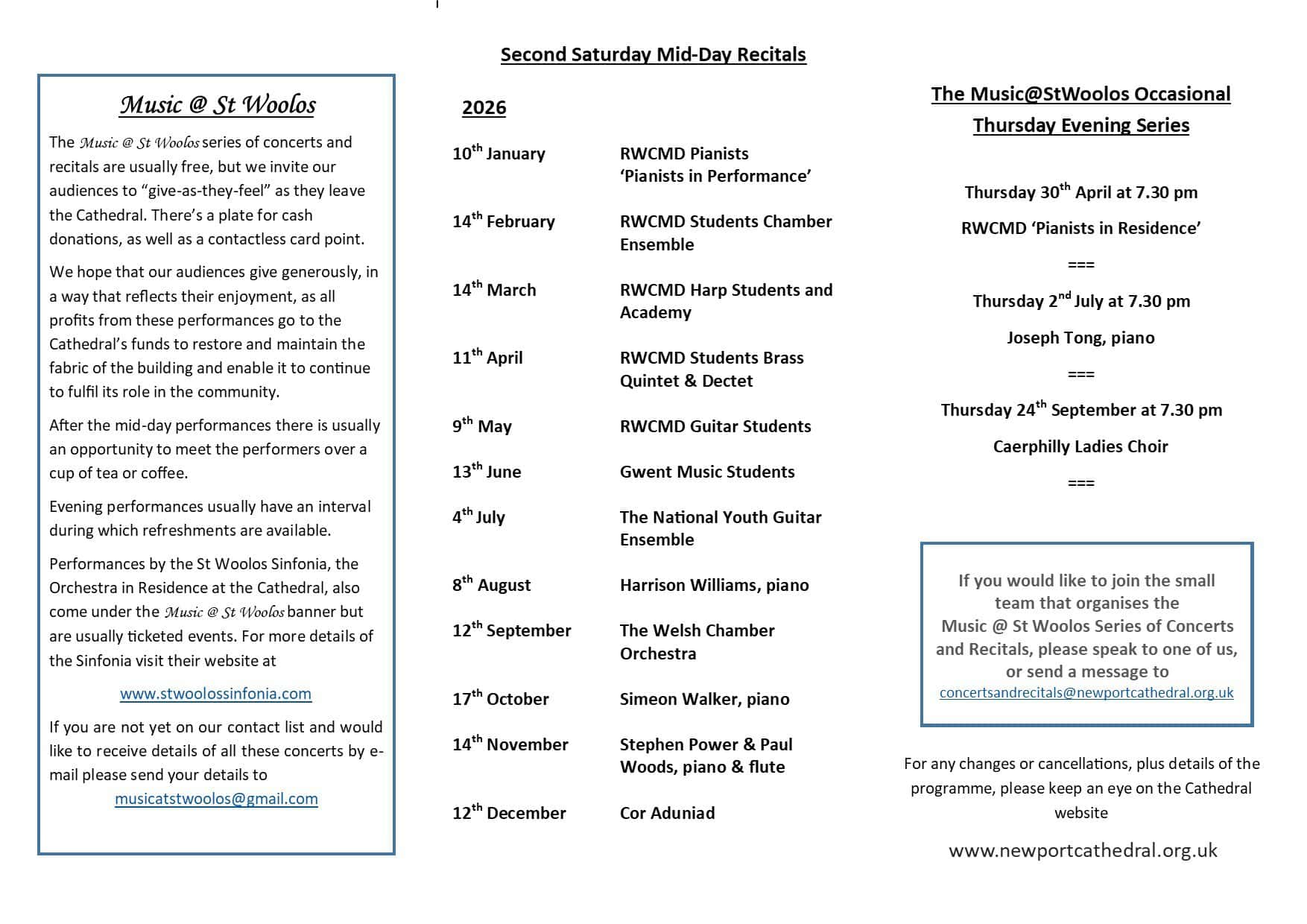
music@stwoolos was formed in order to bring a regular series of recitals and concerts to the Cathedral. Musicians and musical groups are often booked a year in advance, and details of upcoming musical events are posted here on the website, as well as in the weekly Notices (part of the Sunday Service Sheet) and on the screens as you enter the Cathedral.
The Saturday Midday Series (generally held on the second Saturday of each month) will often afford the opportunity for students from the Royal Welsh College of Music and Drama to hone their performance skills, as well as helping to raise funds for the Cathedral to restore and maintain the fabric of the building and enable it to continue to fulfil its role in the community.
The programme for the whole of the year can be viewed by clicking the button below:
+ Nearby:
Park
Shops
Restaurants
Travel Information
For further travel information in Wales please see: www.traveline.cymru/travel-info
Or call Traveline Cymru on 0800 464 0000
Location
Nearest Venues


*Distances are calculated in a straight line from the current venue, please allow extra time/distance based on available paths or roads.